

Latinos Revealed as California's Economic Edge: 2026 California LatinoGDP Report
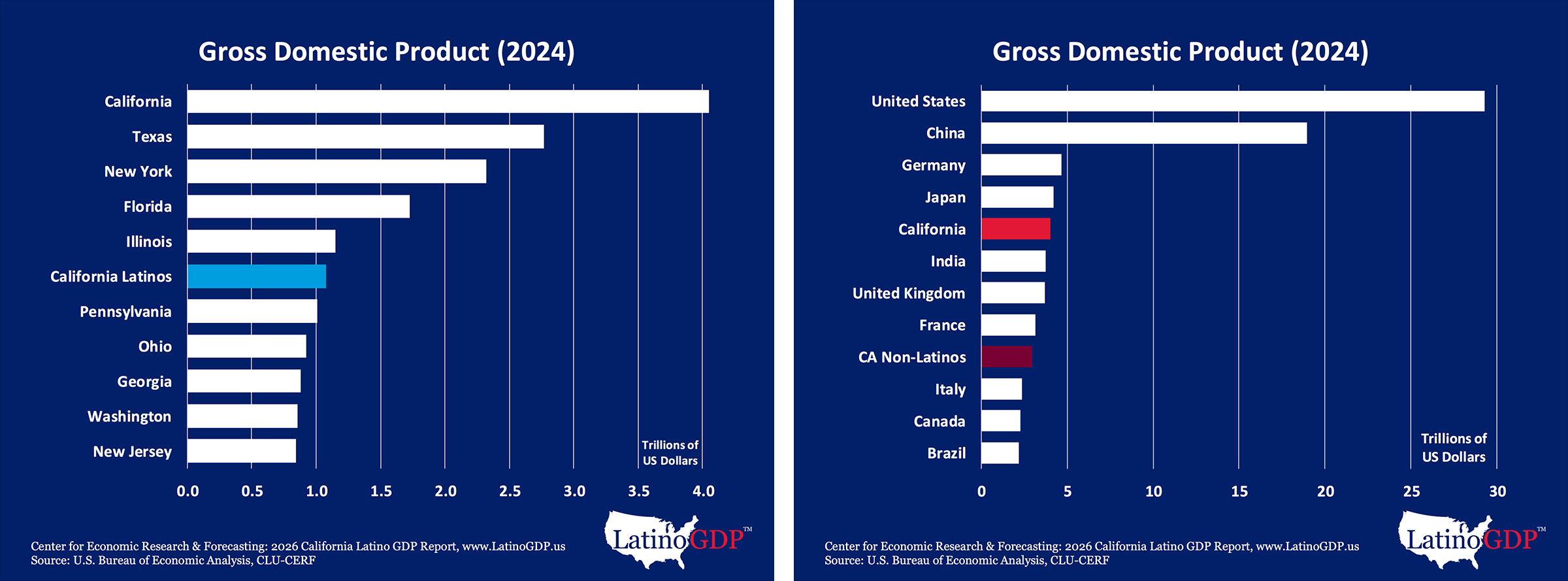
The 2024 California Latino GDP was $1.07 trillion dollars, larger than the entire economy of Switzerland. If California Latinos were a separate U.S. state, the California Latino GDP would be the 6th largest in the U.S., larger than Pennsylvania’s.
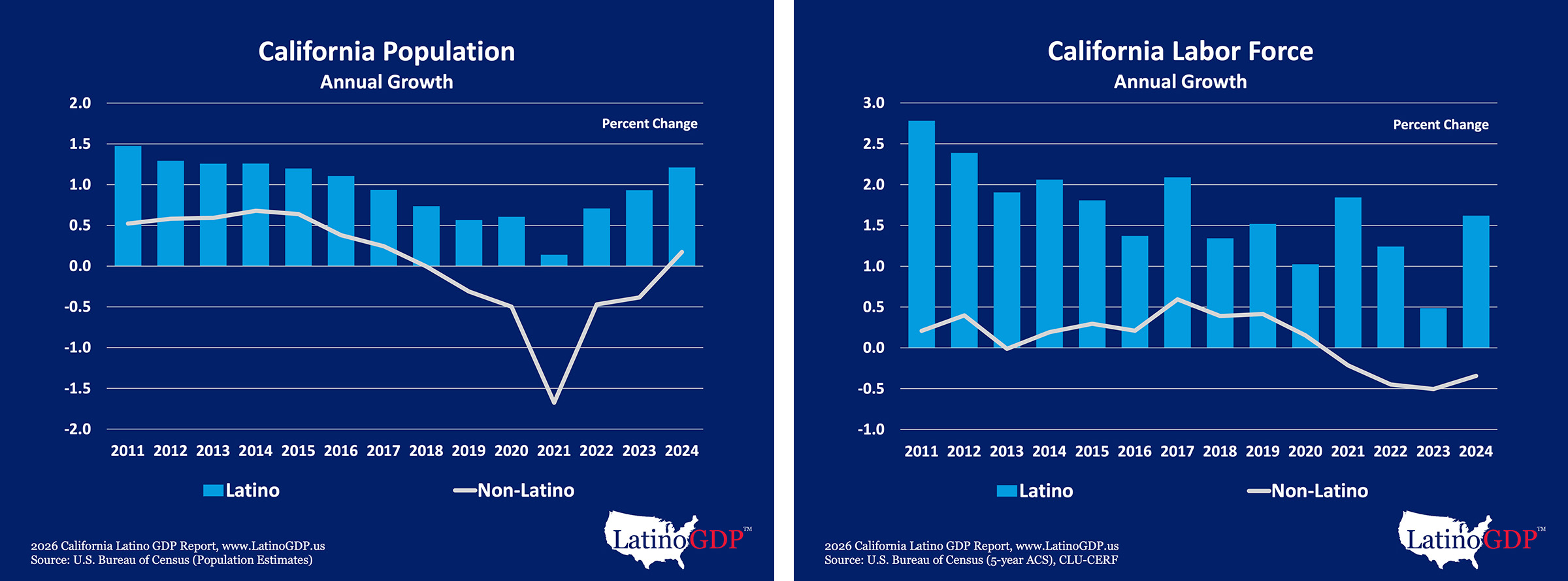
Latinos make up 41 percent of Californians but account for 95 percent of the state's population growth since 2010. Since 2010, California’s Latino labor force has grown nearly 20 times faster than the Non-Latino labor force.

Latinos Revealed as California's Economic Edge
California Latino GDP is growing 2.7 times faster than Non-Latino GDP, as California's Non-Latino economy falls behind the broader U.S. economy.
“For decades California’s relatively rapid economic growth versus the U.S. was a foregone conclusion," said Matthew Fienup, PhD, executive director of Cal Lutheran’s Center for Economic Research and Forecasting (CERF) and a co-author of the report. From 1997 to 2019, California's economy grew 57 percent faster than the nation's. Since the pandemic, however, the state has fallen behind. From 2019 to 2024, California GDP grew 12.6 slower than U.S. GDP. Without Latinos, that gap would have been more than 37 percent.
In 2024, California GDP again grew faster than the nation’s, although only modestly. During that year, the state's non-Latino economy grew only 2.2 percent.
“Without Latinos, California would have fallen well behind the rest of the country,” said Dan Hamilton, PhD, a professor of economics at Cal Lutheran and the report’s Principal Investigator. “But Latinos are such strong drivers of economic growth and such a dependable source of economic resilience that they elevate the entire California economy both nationally and on the global scale.”
The new report helps put the scale of California’s Latino economy into perspective. The 2024 California Latino GDP is $1.07 trillion, or larger than the entire economy of Switzerland. In 2024, the overall California State GDP was $4.05 trillion dollars, representing the 5th largest GDP in the world, after Japan. Without Latinos, the California GDP would be merely the 8th largest GDP in the world.
The report notes the increasingly critical role of California’s Latino population and labor force. Latinos make up 41 percent of Californians but account for 95 percent of the state's population growth since 2010. Since 2010, California’s Latino labor force has grown nearly 20 times faster than the Non-Latino labor force. The report also notes rapidly growing human capital among California Latinos. The number of California Latinos with a bachelor’s degree or higher education is growing 3.5 times faster than the number of highly educated non-Latinos.
"It's not possible to imagine a bright future for California's economy without Latinos," said David Hayes-Bautista, PhD, founder of the LatinoGDP Project and Distinguished Professor of medicine at UCLA.
This year’s report is the 32nd full-length report produced by the LatinoGDP Project, a collaboration between Community Partners, UCLA's Center for the Study of Latino Health & Culture and Cal Lutheran's Center for Economic Research & Forecasting. The 2026 California LatinoGDP Report builds on research released earlier this year detailing the economic impact of U.S. Latinos on the nation’s economy. The 2026 U.S. LatinoGDP, released in May, revealed that the direct economic output of U.S. Latinos surged past $4.4 trillion in 2024. For the first time, the economic contribution of U.S. Latinos has surpassed the GDP of Japan, elevating the Latino GDP to the World’s fourth largest GDP. Since the start of the COVID-19 pandemic, the Latino GDP is the single fastest growing among major economies, growing even faster than India and China.
To download the full report, visit latinogdp.us. Watch Matthew Fienup and David Hayes-Bautista’s fireside chat with Univision Primetime Anchor Gabriela Teissier by following the link on the LatinoGDP website. Reports for various other geographies, including the 2026 U.S. LatinoGDP Report, are also available. For questions about the reports, contact Fienup (mfienup@callutheran.edu) and Hayes-Bautista (dhayesb@ucla.edu).
Center for Economic Research and Forecasting (CERF)
CERF is a nationally recognized economic forecasting center. CERF economists Matthew Fienup, Ph.D., and Dan Hamilton, Ph.D., are members of the Wall Street Journal Economic Forecasting Survey, the National Association of Business Economics (NABE) Economic Outlook survey, the Fannie Mae (formerly Case-Schiller) Home Price Expectations Survey, and the Indeed Labor Market Survey. They are recipients of a 2025 Crystal Ball Award for the Fannie Mae forecast survey, their fifth award in seven years. CERF is housed at California Lutheran University, a federally designated Hispanic-Serving Institution. www.clucerf.org
Center for the Study of Latino Health and Culture (CESLAC)
Since 1992, CESLAC has provided cutting-edge research, education and public information about Latinos, their health and their impact on California’s economy and society. CESLAC is a resource for community members, business leaders and policy makers who want to gain insightful research and information about Latinos. It offers unparalleled insight into Latino issues through an approach that combines cultural research, demographic trends and historical perspective.
History of the LatinoGDP Project
The effort to calculate the Latino GDP began with David Hayes-Bautista in the early 2000s. His idea was to use established government data programs to calculate a robust summary statistic for the economic performance of U.S. Latinos. The original U.S. Latino GDP algorithm was developed by Hayes-Bautista with Werner Schink, former chief economist of the California EDD. They produced the inaugural U.S. LatinoGDP Report in 2017. After Schink’s untimely passing, Hayes-Bautista sought out Cal Lutheran economists Dan Hamilton and Matthew Fienup. Hayes-Bautista, UCLA colleague Paul Hsu, Hamilton and Fienup made refinements to the LatinoGDP methodology and have produced annual LatinoGDP Reports since 2019. The LatinoGDP Project was significantly expanded in 2021 and now includes calculation of the Latino GDP for targeted states and major metropolitan areas, as well as the inaugural U.S. LatinaGDP Report, released August 2024. For more information and to access reports, visit www.latinagdp.us and www.latinogdp.us.
Matthew J Fienup
Latino GDP Project
email us here
Fireside Chat with Univision's Gabriela Teissier
Legal Disclaimer:
EIN Presswire provides this news content "as is" without warranty of any kind. We do not accept any responsibility or liability for the accuracy, content, images, videos, licenses, completeness, legality, or reliability of the information contained in this article. If you have any complaints or copyright issues related to this article, kindly contact the author above.
